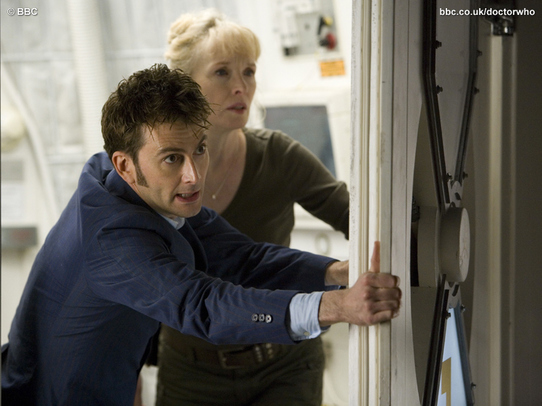
The Waters of Mars (debuting on Canada’s Space network, Saturday, December 19 at 9 p.m.) is the culmination of a number of things. It is the beginning of the end of the tenth Doctor as his regeneration saga begins. It is the end of a mini-arc of stories where the Doctor is effectively companionless. And, most importantly, it is the moment that Donna Noble explicitly warned him about when, during The Runaway Bride, she told the Doctor that he needed someone.
Donna: Promise me one thing. Find someone.
The Doctor: I don’t need anyone.
Donna: Yes, you do. ‘Cause sometimes I think you need someone to stop you.
The Doctor: Yeah…
For the past year, now — three specials and who knows how many years within the continuity, the tenth Doctor has eschewed companionship. After losing Rose, Martha and finally Donna, he’s no longer letting anyone get close to him. And he should have listened to Donna’s warning, because this is the moment when the Doctor finally goes over the edge.
The Waters of Mars is also an interesting study of an episode that works fully and completely on an emotional level, but which fails in the cold light of logic. Not that this matters. I, my wife, and numerous other fans have found ourselves willing to forgive this episode its faults, admiring it not for what it achieved, but for how it was able to communicate for our understanding what it was trying to achieve.
Massive spoilers follow. Look away now if you don’t wish to be spoiled.
Still playing the sightseer, the Doctor lands his TARDIS on Mars and goes exploring in his space-suit. To his delight, he finds himself looking down on a Martian base that the humans have established. And if a robot with a gun trundles out from behind a rock to take him prisoner… well, it’s all a part of the ride, isn’t it?
But things start going downhill almost immediately. Though the crew’s understandable suspicion is melted away without even the use of psychic paper, the Doctor learns several uncomfortable facts. The year is 2059. This isn’t just any human Martian base, it’s the first one. The date is November 21, and this is the date when Captain Adelaide Brooke (well played by Lindsay Duncan) inexplicably orders the detonation of the base’s nuclear stores, destroying the base and all hands in it.
The Doctor knows that he’s got to leave, now. As far as he’s concerned, he’s stepped into a William Hartnell historical story where he’s caught up in historical events, and forced to extricate himself as quickly and cleanly as possible without — and we cannot emphasize this enough — changing the course of Time.
Captain Brooke knows that something is up. And as a mysterious virus starts to change the crew into water-spewing vessels for some alien influence trapped under the Martian polar ice, she demands that the Doctor comes clean. And such is the chemistry between the two that the Doctor explains that what is to happen must happen, and that it will all be for the best in the end… and somehow Captain Brooke finds herself surprisingly able to accept it.
Despite some key problems with the writing, that I’ll go into later, the script (by Russell T. Davies and Phil Ford) functions exceptionally well. Everything serves the story, and the basic plot and the emotional core all hold together. The characters are all well drawn (and well acted), with lots of dialogue suggesting at some considerable backstory here (especially between Captain Adelaide Brooke and first officer Ed Gold), which I greatly appreciated. The direction held together as well (which is as much as you’d expect from Graeme Harper). I did chuckle at some points. The motif of flashing on web page obituaries each time a character introduced him or herself to the Doctor works well to start, but gets overdone (“who are you?” “I’m Joe the janitor!” “CUE OMINOUS WEB PAGE!! — When I said that, Erin shouted “Oh, my God! Somebody messed with Lindsay’s Wikipedia entry!”) and the moment where the Doctor first soups up the funny robot — much to the chagrin of the robot’s VR controller — is pretty dorfy. The water-spewing monsters of this story walk the fine line between silly and creepy, before stepping firmly into creepy territory, however (I think it’s the eyes that do it), and there are a lot of good character moments as the crewmembers defiantly struggle to survive against the onslaught, only to fall to the inevitable, one by one.
(Seriously, now: major spoilers to follow. Turn away if you don’t want to be spoiled).
The last fifteen minutes appealed to Erin and I most strongly on an emotional level, however — and the initial reaction on Twitter (where Doctor Who actually trended for a good solid hour after the episode’s broadcast) would suggest that we were far from alone. David Tennant makes this work through one of the strongest bits of physical acting of his career as the Doctor. He says almost nothing, but the pain on his face as he listens to the radio chatter as each of the crewmembers succumb to the march of history is fearsome to behold, and the moment when he snaps, when he realizes that he’s the last Time Lord and there is nobody but himself to stop him from doing as he pleases to the nature of causality, is the touchstone moment of his character. The Doctor turns his back on all that he has stood for in the past, and decides that he and he alone will finally decide who gets to live, and who gets to die.
This new, arrogant Doctor who snatches Captain Brooke and crewmembers Yuri and Mia from the jaws of history and deposits them on Earth, is a masterful performance by David Tennant, and that pun is absolutely intended. Also effective is the argument that follows, as Captain Brooke calls the Doctor out on his arrogance, and rightly sees this change as something dangerous for the universe. Her decision to kill herself is as inevitable as the history the Doctor strove to avoid, and the Doctor’s sudden comedown from his arrogance, and his realization of what he was about to become, is also fearsome to behold. The final fifteen minutes of The Waters of Mars were more than enough for Erin and myself to put this episode well into the ‘win’ column.
But trust the rational Cameron to rain on our parade. He, and anybody else who takes a moment to think things through, will have noticed that the argument between the Doctor and Captain Brooke, following the Doctor’s “screw causality” moment, is based on a number of false premises. I’ll let Cameron speak for himself:
There were so many options available… …Why didn’t he just drop them off at the far end of the Universe? History says they died, but “died” is in some ways a synonym for “went away and never came back.” The letter of history could have been preserved and they still could have lived long, full lives somewhere else in time and space.
The option was there, but nobody mentioned it. Adelaide should have mentioned it. The Doctor could still have shot her down: “Nope, I’m the Doctor, and what I say goes. You’ll live a long full rich life here on Earth and you’ll like it or I’M COMING FOR YOU.” Sort of thing. But no, the alternative doesn’t even seem to occur to her. She’s smart, she’s driven, she should have tried to come up with some workaround for the Doctor. She doesn’t even try. Just gives up. “History says we should have died; ergo, you should have let us die.”
But again, I get that this is about the Doctor getting all masterful, as it were. So maybe Adelaide felt she needed to die… …to stop the Doctor from going mad with power. Again, she should have said something. The dialogue doesn’t have to be anvilicious, but there has to be something there. “This isn’t about me, it’s about you.” The Doctor isn’t interfering because Adelaide deserves to live, he’s interfering in order to make himself feel better. Yes, he’s sacrificing humanity’s future for the sake of one person, but that one person isn’t Adelaide, it’s him. That’s why she needs to press the reset button on her gun.
But if that’s the case… then she should do it in front of him. She walks into her house, closes the door, and there’s a fwoomp sound and flash of light through the window, while the Doctor is looking the other way. What if he’d missed it? “What was that? Car backfiring? Oh well. Hey, Hitler! (cocks gun)”
If she absolutely positively had to be dead overnight, she should have waited until he was far enough away, called out his name, and shot herself right in front of his eyes.
Too graphic? We didn’t have to see it — she could have lifted the gun and we could have cut to the Doctor’s horrified reaction.
I would rebut some of this by saying that, since the Doctor is a Time Lord, he didn’t need to see Adelaide shooting herself. The sudden appearance of the newly altered web pages strongly suggest that he can feel the changes in the time stream that he’s made, but the changes aren’t the changes that he’s wanted. But Cameron has got a point: why didn’t anybody suggest taking Captain Brooke and the two other surviving crewmembers out to the stars, where they very much wanted to be in the first place? Some explanation here can be found in the fact that the Doctor hasn’t taken on a new companion since Donna left, but writers Davies and Ford scoot past this quickly in their drive to push their preordained ending to their story.
But you have to give Davies and Ford a lot of credit: they took much of the audience with them. I bought the story without noting that there were alternatives for Captain Brooke and her crew. I completely missed the fact that this story is needlessly pessimistic in assuming that Adelaide’s granddaughter could not be inspired to go to the stars with anything other than her grandmother’s death. There is an indescribable quality about The Waters of Mars that made me and Erin root for it, and latch onto the story that we wanted to see and what Davies and Ford wanted to tell — rather than the story that they actually told.
If you could bottle that quality, writers everywhere would pay good money for it. But there’s a good chance that literature might suffer as a result.